
Complete Byzantine City Discovered Beneath Sands of Egypt’s Dakhla Oasis
Complete Byzantine City Discovered Beneath Sands of Egypt’s Dakhla Oasis
————————————————
An Egyptian archaeological mission affiliated with the Supreme Council of Antiquities has announced the discovery of a complete residential city dating back to the Byzantine era during excavations at the Ain Al-Sabil archaeological site in the Dakhla Oasis, New Valley Governorate.
The discovery sheds new light on urban and social life in Egypt hundreds of years ago.
Minister of Tourism and Antiquities Sherif Fathy said the discovery is an important addition to Egypt’s archaeological record and highlights the cultural diversity witnessed by Egyptian oases throughout history. He added that such findings help strengthen New Valley Governorate’s position on the cultural tourism map and support development efforts in the region.
Hisham El-Leithy, secretary-general of the Supreme Council of Antiquities, said the newly discovered city provides valuable information about daily life in the Dakhla Oasis during the Byzantine period, helping researchers better understand urban and social development at the time.
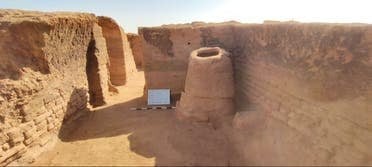
Diaa Zahran, head of the Islamic, Coptic, and Jewish Antiquities Sector, said the city was built entirely of mud brick according to an organized urban plan. Its main streets run from north to south and intersect with cross streets, creating public squares. A large basilica church stands at the center of the city, overlooking one of the main streets.
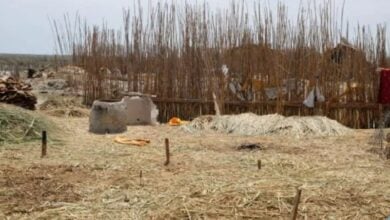
Mahmoud Massoud, head of the archaeological mission and director-general of Dakhla Antiquities, said the city included complete facilities, including a church dating back to the mid-fourth century AD, two watchtowers, a defensive fortress, houses with spacious halls and vaulted ceilings, bread ovens, kitchens, and grain-grinding tools. He said these features reflect the presence of a stable and integrated community.
The mission also uncovered a house belonging to a church deacon named Tissos, as well as another house attributed to Tabibos, which is believed to have been used as a house church before the basilica church was built.
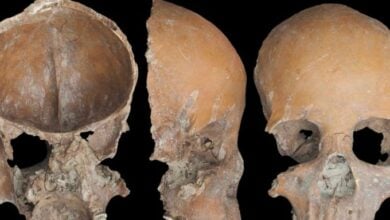
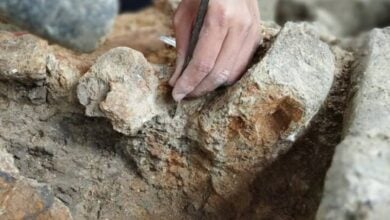
Excavations also revealed a wide range of archaeological finds, including pottery vessels, bottles used to store oils and perfumes, lamps, stone tools for grinding grain, and around 200 ostraca written in Coptic and Greek. The inscriptions document commercial transactions and daily correspondence among residents.
The mission also found bronze coins bearing images of Byzantine emperors and Christian symbols, along with rare gold coins dating back to the reign of Byzantine Emperor Constantius II, who ruled from 337 to 361 AD.
The discovery is considered one of the most significant recent archaeological finds in Egypt’s oases, offering important evidence of urban and religious life during the Byzantine era and enriching studies on Egypt’s ancient history and civilizational development.