
Mount Arafat: A Geological Marvel Dating Back Nine Million Years
Mount Arafat: A Geological Marvel Dating Back Nine Million Years
——————————
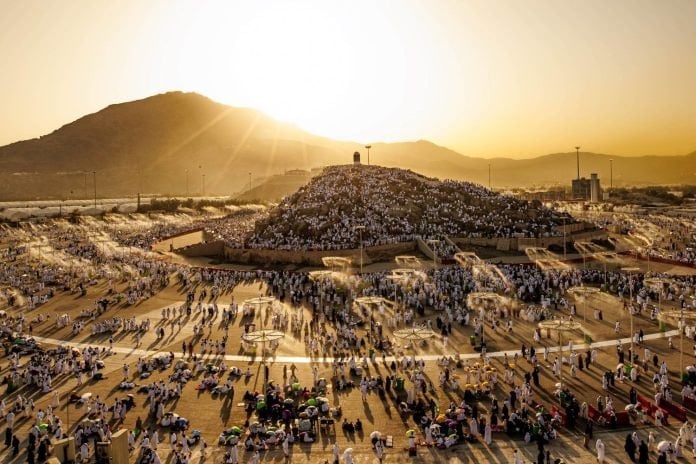
Mount Arafat, revered by Muslims as the site of the pivotal standing ritual during the Hajj pilgrimage on the Day of Arafah, holds significance beyond its spiritual and religious symbolism. Recent geological studies reveal that the mountain also tells a story dating back approximately nine million years, offering insight into the formation of the Arabian Peninsula and the Red Sea.
According to a study published in a specialized journal on nuclear chemistry and radiometric analysis, researchers determined that Mount Arafat is composed primarily of granodiorite, a deep-seated igneous rock formed from slowly cooled magma beneath the Earth’s crust. This composition provides the mountain with high durability and a mineral structure containing quartz, feldspar, and mica.
Scientists used fission-track dating, a precise method analyzing natural uranium decay trails in mineral crystals over millions of years, to establish the mountain’s geological age. The findings suggest that Mount Arafat formed during the late Miocene epoch, coinciding with tectonic shifts that gradually separated the Arabian Peninsula from Africa and contributed to the opening of the Red Sea.
The study also assessed natural radioactivity levels in the mountain’s rocks, confirming that uranium, thorium, and potassium levels are within safe international limits, posing no health risk to pilgrims or visitors.
Geologists emphasize that Mount Arafat represents a unique convergence of spiritual and natural history. Beyond its central role in Islamic rituals, the mountain serves as a living geological record, preserving evidence of early Earth formation processes in the Arabian Peninsula and standing as a silent witness to transformations spanning millions of years.