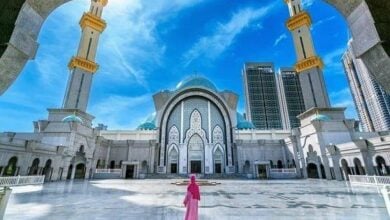

Malaysia’s Royal Klang Mosque Showcases Harmony Between Chinese Architecture and Islamic Art

Malaysia’s Royal Klang Mosque Showcases Harmony Between Chinese Architecture and Islamic Art
——————————————–
The Royal Klang Mosque in Malaysia’s Selangor state has emerged as a distinctive religious and cultural landmark, reflecting the country’s multicultural heritage through an architectural design that combines traditional Chinese elements with Islamic artistic features.
Located in Bandar Botanic, Klang, the mosque was established with support from the Malaysian Chinese Muslim Association and the Sultan of Selangor, Sultan Sharafuddin Idris Shah, as part of an initiative to highlight the cultural diversity of Malaysia’s Muslim community.
Construction began in late 2019 following architectural research in China and was completed in August 2024, despite delays caused by the COVID-19 pandemic. The project cost approximately 19.3 million Malaysian ringgit, equivalent to around $4.7 million.
Inspired by the historic Great Mosque of Xi’an in China, the building features traditional Chinese-style sloping roofs covered with grey tiles, red walls and a three-storey pagoda-inspired minaret. These elements are combined with Islamic architectural details and Arabic calligraphy, creating a distinctive design that reflects the historical interaction between Chinese and Islamic cultures.
The mosque accommodates more than 1,000 worshippers and includes an Islamic art exhibition, a library containing copies of the Holy Quran translated into Mandarin, and cultural and educational facilities. Its prayer niche also incorporates Arabic calligraphy influenced by Chinese artistic traditions.
Beyond serving as a place of worship, the mosque provides opportunities for cultural exchange and education about the history and contributions of Chinese Muslims. It has also attracted visitors, tourists and media attention because of its distinctive architecture.
The Royal Klang Mosque reflects Malaysia’s broader multicultural character, demonstrating how Islamic religious identity can coexist with diverse architectural traditions while promoting understanding and closer relations among different Muslim communities.