
Iraq: Major Fatimiyya Mourning Processions Held in Najaf, Hillah as Baghdad Hosts Cultural Awareness Activities
Iraq: Major Fatimiyya Mourning Processions Held in Najaf, Hillah as Baghdad Hosts Cultural Awareness Activities
——————————————–
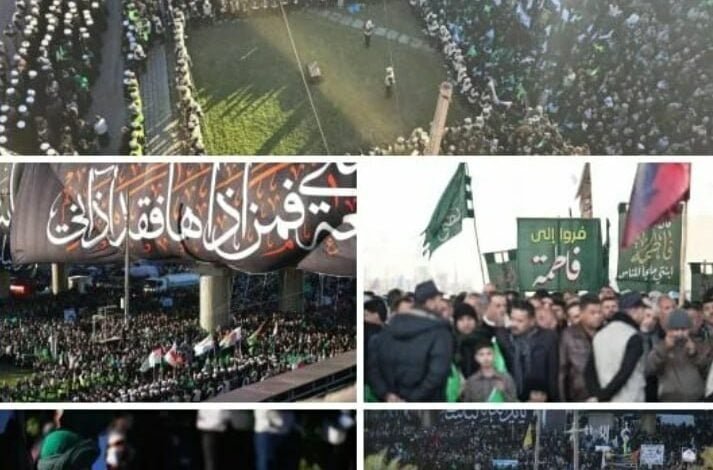
Thousands of followers of Ahl al-Bayt (peace be upon them) took part in major mourning processions in the Iraqi cities of Najaf and Hillah, commemorating the martyrdom anniversary of Lady Fatima al-Zahra (peace be upon her). Meanwhile, a religious procession in Baghdad organized cultural and educational activities highlighting her life, suffering and legacy.
In Najaf al-Ashraf, the annual Grand Fatimiyya Procession took place on Saturday morning, attracting large numbers of religious scholars, seminary students, mourning groups and mourners arriving from various Iraqi provinces. Participants marched from the city centre towards the holy shrine of Imam Ali ibn Abi Talib (peace be upon him) in the Old City, expressing their grief and devotion to the daughter of the Holy Prophet (peace be upon him and his family).
In Hillah, the capital of Babil Province, more than 5,000 male and female mourners participated in the Grand Fatimiyya Procession. The gathering began at the shrine of Sayyid Ali ibn Tawus and proceeded towards the Maqam of Imam al-Mahdi (may Allah hasten his reappearance). Religious poetry and Hussaini elegies commemorated Lady Fatima’s suffering following the passing of her father. The procession was followed by a central mourning assembly featuring poetry, a religious lecture and elegies. Organizers and servants of the holy shrines provided logistical and service support.
In Baghdad, the Jawadayn Procession, under the supervision of Hujjat al-Islam Sheikh Ahmed Lami, representative of Grand Ayatollah Sayyid Sadiq al-Husseini al-Shirazi, organized educational and cultural programmes. Activities included answering religious and theological questions, presenting historical accounts and scholarly perspectives from Shia and other Islamic traditions concerning the events surrounding Lady Fatima’s house, the injuries she suffered and the martyrdom of Muhsin ibn Ali (peace be upon him). A theatrical performance depicting her suffering was also staged, alongside the distribution of Fatimiyya offerings.