

Rights Report Accuses Indian Authorities of Systematic Discrimination Against Muslims
Rights Report Accuses Indian Authorities of Systematic Discrimination Against Muslims
—————————————–
A rights report by Geneva-based ArtE Academy has accused Indian authorities of overseeing what it describes as a decade of “systematic discrimination and human rights violations” against Muslims, citing laws, government measures and episodes of communal violence since 2014.
The report, published in March 2026 under the title Unequal Citizens: Systematic Discrimination and Human Rights Violations Against Muslims in India, 2014–2025, examines developments since Prime Minister Narendra Modi’s Bharatiya Janata Party (BJP) came to power nationally.
According to the report’s authors, the study was prepared for submission to the United Nations Human Rights Council, international rights organizations, and academic and legal institutions. It focuses on hate speech, citizenship laws, communal violence, property demolitions, arrests, restrictions on religious practices and conditions affecting marginalized Muslim communities.
The report cites data showing that incidents of hate speech targeting minorities rose from 668 in 2023 to 1,318 in 2025, an increase of nearly 97 percent. It said 1,164 of the incidents recorded in 2025 occurred in states governed by the BJP, with Uttar Pradesh reporting the highest number. The BJP has rejected conclusions linking the concentration of such incidents to its political rule and rhetoric.
The study also criticized India’s 2019 Citizenship Amendment Act, which provides an expedited path to citizenship for migrants from six religious communities from Afghanistan, Bangladesh and Pakistan, while excluding Muslims. The report said the law has prompted concerns among international rights groups.
It also examined the National Register of Citizens in Assam, noting that around 1.9 million people were excluded from the final list and raising concerns over the potential risk of statelessness, particularly among Bengali-speaking Muslims.
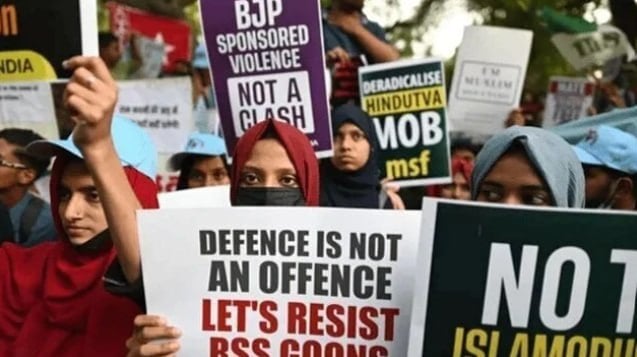
The report highlighted the February 2020 communal violence in northeast Delhi, in which at least 53 people were killed, with Muslims accounting for the majority of victims. Citing rights reports, it alleged that some police personnel either participated in attacks or failed to protect Muslim residents.
The study also referred to the 2002 Gujarat violence, the 2013 Muzaffarnagar violence and the 2020 Delhi unrest as examples of recurring communal violence and ongoing questions over accountability and justice.
On property demolitions, the report examined what has been termed “bulldozer justice” in India. It cited data indicating that more than 740,000 people were displaced by demolitions in 2022 and 2023, with more than 150,000 homes demolished. Amnesty International has also documented the demolition of thousands of properties in several states.
The report noted that India’s Supreme Court imposed legal restrictions in November 2024 on demolitions being used as punishment against accused individuals. Its authors nevertheless said civil society groups continued to document demolitions in 2025. Local authorities, meanwhile, maintain that such operations target structures that violate building regulations rather than serving as collective punishment.
The study further raised concerns over the use of the Unlawful Activities (Prevention) Act against activists, students and journalists, citing prolonged pretrial detention and low conviction rates in cases registered under the law.
It also documented the government response to protests against the Citizenship Amendment Act in Uttar Pradesh between December 2019 and January 2020, reporting deaths, thousands of arrests and police cases involving large numbers of suspects.
The report called for stronger legal accountability, greater protection of Muslims’ civil and religious rights, and action against hate speech and discrimination. It also urged international legal and human rights institutions to continue monitoring the situation of religious minorities in India.