
Nepal: 472 Bodies Found, Search Continues for Hundreds of Missing
Nepal: 472 Bodies Found, Search Continues for Hundreds of Missing
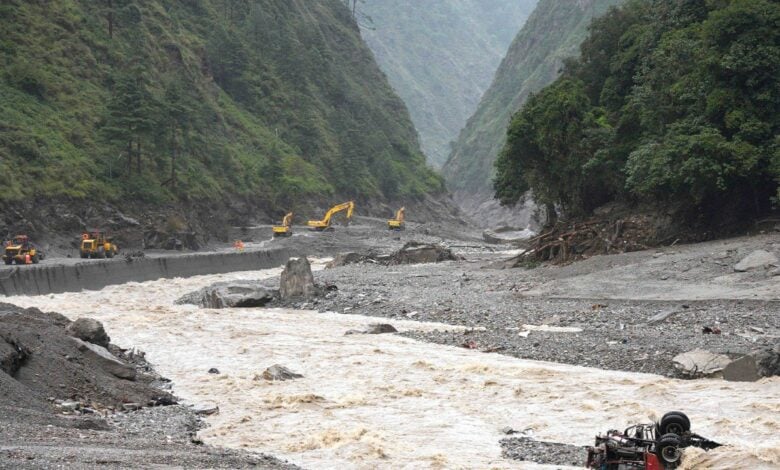
The Himalayan region is facing one of the worst natural disasters in its modern history, as rescue teams race against time to find survivors amid massive floods and avalanches that have swept through Nepal and the Tibet region of China. The catastrophe, described as a “tsunami of mud and frozen water,” has resulted in the deaths of at least 472 people, with more than 1,400 others still missing.
In Nepal, the army is focusing its efforts on a complex operation to rescue about 100 people trapped inside a tunnel belonging to the “Trishuli A3” hydroelectric project. Army spokesperson Raja Ram Basnet stated that identifying the tunnel entrances poses an enormous challenge due to the accumulation of mud and debris, despite the earlier evacuation of 350 workers and residents from the surrounding area.
Conversely, Chinese authorities have suspended rescue operations in the affected region of Tibet, specifically near the “Gyirong” border center, due to fears of an explosion from a newly-formed glacial lake caused by debris accumulation, which threatens to unleash a new flood wave that could sweep away the remaining parts of the region.
According to official reports, the death toll in Nepal alone has reached 469 people, while Tibet has recorded three deaths, with the search for hundreds of missing individuals ongoing. The missing persons list includes 910 people who have lost contact in Nepal, among them 517 foreign tourists of American, British, Malaysian, Canadian, and Australian nationalities.
Concerns are also rising about the fate of dozens of Hindu pilgrims on a journey to the sacred Mount Kailash in Tibet, as communication has been completely lost with entire tourist groups since the disaster struck last Wednesday.
The United States Geological Survey confirmed that the disaster was triggered by a powerful avalanche, the worst in the region since the 2015 earthquake. Climate experts have warned that the accelerated melting of glaciers due to global warming increases the frequency of these sudden floods, which now threaten mountain communities and energy infrastructure projects.
In field hospitals, survivors recount tragic stories; “Kala Priya,” a mother who lost her three homes and son in the torrents, pleaded with rescue teams saying: “I don’t care about money, I just want my son back.” In Malaysia, “Logatharsini Raman” expressed worries about her family of 17, who lost contact while heading towards the Nepalese-Chinese border.
Internationally, Pope Leo XIV and King Charles III expressed their deep sorrow over the disaster, while the Dalai Lama offered prayers for the victims. International aid continues to pour into the region despite significant logistical challenges caused by the destruction of vital bridges and roads in the heart of the world’s highest mountain range.