
Indian State Launches New Plan to Facilitate Muslim Women’s Access to Higher Education
Indian State Launches New Plan to Facilitate Muslim Women’s Access to Higher Education
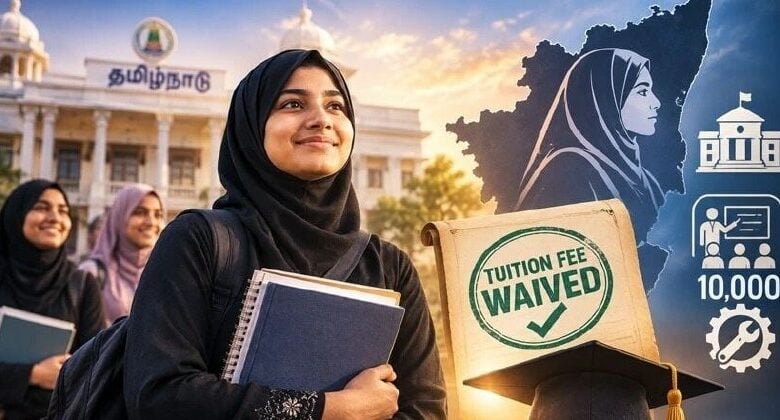
The government of the southern Indian state of Tamil Nadu has announced a new educational scheme that includes covering tuition fees for eligible Muslim female students at the undergraduate level. This initiative is part of a series of measures aimed at expanding educational opportunities and training for religious minorities in the state.
The plan encompasses Muslim female students admitted through government quotas in public universities, government colleges, and state-supported institutions, as well as self-financing private institutions. It covers fields such as humanities, basic sciences, engineering, medicine, agriculture, and law.
Tamil Nadu’s Minister for Minority Affairs, A. M. Shah Jahan, introduced the initiative to the state assembly on August 28, outlining that it is part of a suite of programs aimed at eliminating financial barriers that might prevent Muslim female students from pursuing higher education.
The state government has allocated 200 million Indian Rupees to implement the tuition coverage program, a move intended to help students complete their studies across various disciplines.
Additionally, the government has announced the expansion of the educational support program for Muslim girls provided by the state’s Waqf Board to include students in grades nine and ten, expanding beyond the previous coverage for grades one through eight.
According to government estimates, around 41,000 Muslim female students are expected to benefit from the expanded program, which provides annual financial assistance to each student. Tens of millions of rupees have been earmarked to fund this initiative.
In another step to enhance educational opportunities for minority women, the Tamil Nadu government has also announced plans to establish a new college for humanities and basic sciences in the city of Chennai, dedicated to women from religious minorities.
The package of measures also includes technical and vocational training programs aimed at thousands of minority youth over the coming years, covering fields such as information technology, automotive manufacturing, fashion design, healthcare, and various professional specializations.
According to the announced plans, these measures aim to bolster the educational and vocational training opportunities for religious minorities, particularly Muslim women and girls, and alleviate the financial burdens that may hinder their continuation in education.