
An American Book Highlights the Pivotal Role of Lady Khadija (peace be upon her) in Islamic History
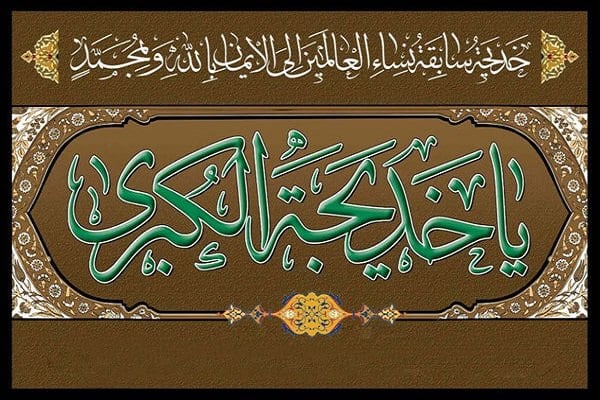
An American Book Highlights the Pivotal Role of Lady Khadija (peace be upon her) in Islamic History
A recent academic book has shed light on the influential role of Lady Khadija al-Kubra (peace be upon her) during the early days of the Islamic mission, emphasizing that her significance was not limited to being the wife of the noble Prophet Muhammad (peace and blessings be upon him), but extended to having a prominent economic and social role in supporting and protecting him during the initial phase of the message.
Imran Iqbal Al-Badawi, Dean of the College of Fine Arts at Tarleton State University in Texas, USA, in his book “Queens and Prophets: How Noble Women and Righteous Men Shaped Arab Paganism, Christianity, and Islam,” considered the presence of Lady Khadija (peace be upon her) and her influence on the religious and social developments witnessed by the Arabian Peninsula during the sixth and seventh centuries AD.
In a chapter dedicated to Lady Khadija (peace be upon her) and Prophet Muhammad (peace and blessings be upon him), the author provides an analysis focusing on her social and economic status in Mecca, and her role in providing support to the noble Prophet (peace and blessings be upon him) during the early years of the mission and facing the pressures encountered by the Islamic call.
Al-Badawi argues that some historical narratives have not given Lady Khadija (peace be upon her) the attention she deserves, indicating that she enjoyed influential economic and social status, in addition to a strong personality and a supportive stance towards the Prophet (peace and blessings be upon him), which contributed to providing the necessary protection and stability for the continuation of the mission in the Meccan environment at that time.
The author also placed Lady Khadija (peace be upon her) within a broader context for studying the presence of women with social status in the history of the Arabian Peninsula and the Near East, highlighting their contributions to shaping aspects of social, cultural, and religious life in the region.
The book notes that the relationship between the noble Prophet (peace and blessings be upon him) and Lady Khadija (peace be upon her) combined family life and economic partnership, before she became the first believer in his message and one of his most prominent supporters at the dawn of Islam.
The author concludes that revisiting the character of Lady Khadija al-Kubra (peace be upon her) and her historical role contributes to providing a broader understanding of the presence and impact of women in early Islamic society, highlighting the central role she occupied in the life of the Messenger of Allah (peace and blessings be upon him) and the course of the Islamic mission.