
India Tightens Security in Delhi Ahead of Protest Demanding Election Chief’s Resignation
India Tightens Security in Delhi Ahead of Protest Demanding Election Chief’s Resignation
——————————————–
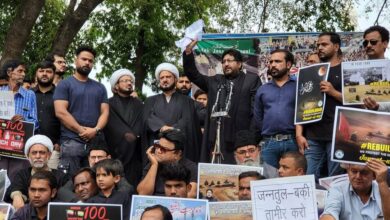
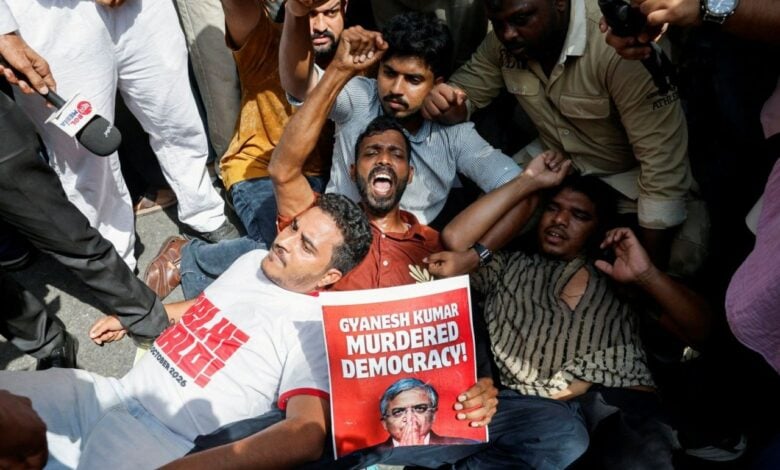
Indian authorities deployed thousands of police and paramilitary personnel across New Delhi on Saturday, October 10, ahead of a major protest demanding the resignation of Chief Election Commissioner Gyanesh Kumar over controversial changes to voter lists.
The demonstration was organised by the Cockroach Janta Party (CJP), a youth-led political movement, under the slogan “Save Democracy.” Protesters accuse the Election Commission of removing eligible voters from electoral rolls in a manner that could benefit Prime Minister Narendra Modi’s ruling Bharatiya Janata Party (BJP).
The voter-list revision reportedly removed more than 130 million names. The Election Commission says the exercise aims to eliminate duplicate and ineligible registrations. The commission and the BJP have denied allegations of political bias.
Police refused permission for the rally at Jantar Mantar, a designated protest site in central Delhi, citing procedural issues and alleged violations during earlier demonstrations. Authorities erected multiple layers of barricades, restricted access to metro stations, cancelled several long-distance trains and suspended mobile internet services within a four-kilometre radius of the protest area until Saturday night.
The restrictions followed reports of widespread detentions linked to the demonstrations. CJP leader Abhijeet Dipke and other movement figures were reportedly detained as they arrived in Delhi. The movement has accused authorities of attempting to prevent people from joining the rally.
India’s Supreme Court questioned the extent of the transport restrictions, saying public transportation should not be shut down completely and that security measures must be proportionate.
The demonstrations have continued for weeks, with protesters and opposition groups arguing that the voter-list revision risks disenfranchising millions of people, particularly members of marginalised communities. The dispute has intensified ahead of state elections expected in early 2027, including in Uttar Pradesh, India’s most populous state.
The Election Commission maintains that the revision is intended to improve the accuracy of electoral rolls, while the BJP has accused opposition groups of misleading the public.