
Astronomers Detect Record-Breaking Radio Burst from Early Universe
Astronomers Detect Record-Breaking Radio Burst from Early Universe
———————————–
Astronomers have detected what researchers believe is the most distant fast radio burst (FRB) ever recorded, a powerful pulse of radio waves that travelled for more than 10 billion years before reaching Earth.
The burst, designated FRB 20240304B, originated when the universe was approximately three billion years old, meaning its signals have travelled across roughly 80 percent of cosmic history. The findings were published in the journal Science.
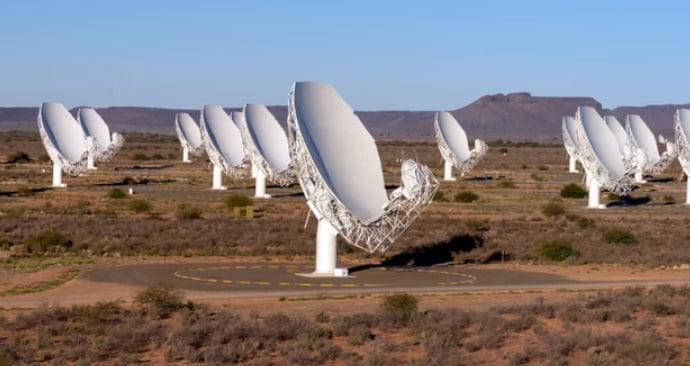
Researchers detected the burst using the MeerKAT radio telescope in South Africa and identified its host galaxy with NASA’s James Webb Space Telescope. Observations indicate that the galaxy is small, young and rapidly forming stars, with relatively low concentrations of heavy elements.
Fast radio bursts are intense radio-wave pulses that can release enormous amounts of energy in milliseconds. More than 10,000 have been detected since their discovery in 2007, but their origins remain uncertain. One leading explanation links some bursts to magnetars, highly magnetised neutron stars.
Scientists say the discovery could help explain how these bursts occur in the early universe and provide a new way to measure matter that cannot be directly observed. As radio waves travel through space, they interact with particles along their path, allowing researchers to estimate the amount of otherwise invisible matter between their source and Earth.
Researchers say further observations of distant bursts could improve scientists’ understanding of the distribution of matter and the evolution of the early universe. It remains unclear whether FRB 20240304B will produce additional detectable signals.