
Law and Political Science Removed from Universities as Taliban Politicize Afghan Higher Education
Law and Political Science Removed from Universities as Taliban Politicize Afghan Higher Education
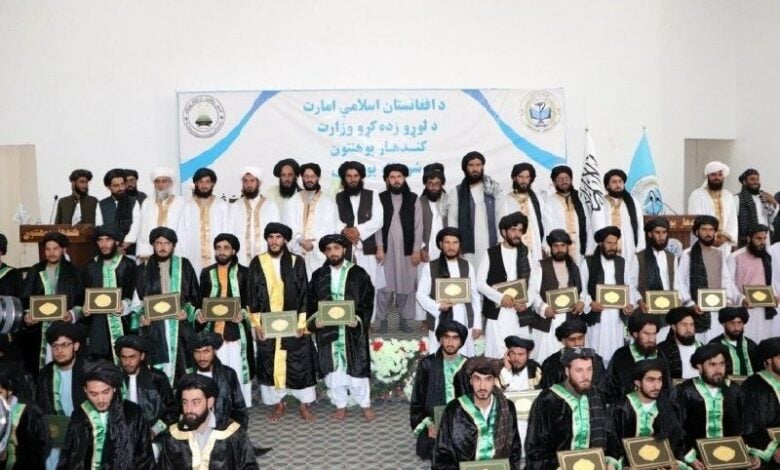
The Taliban continues to reshape Afghanistan’s higher education sector through decisions affecting academic disciplines, curricula, textbooks, professors, and the administrations of academic institutions. Among these policies are measures that directly affect Shia Muslims, Ja’fari jurisprudence, and educational institutions affiliated with the community.
In its latest move, the Taliban’s Ministry of Higher Education ordered the removal of law and political science programs from private universities, citing declining student numbers in law, political science, and international relations faculties, as well as limited employment opportunities for their graduates. The ministry called on universities to submit proposals for alternative disciplines.
The decision comes after sweeping changes introduced by the Taliban across state institutions since its return to power. Reliance on graduates of law, political science, and international relations has declined, while clerics and individuals affiliated with the movement have been appointed to a number of judicial and political institutions.
Universities have also removed courses related to concepts of modern government, human rights, democracy, electoral systems, good governance, globalization, and development, in addition to eliminating fields such as music, cinema, and sculpture.
Restrictions have also extended to educational resources. Authorities have banned a large number of Iranian books and works published by Iranian publishers, as well as books written by women. According to a previously published list, around 310 of 680 rejected educational titles were authored by Iranian writers or published by Iranian publishers.
One of the most prominent measures affecting Shia Muslims has been the removal of Ja’fari jurisprudence from academic instruction. The Ministry of Higher Education halted its teaching at Bamyan University and ordered Hanafi jurisprudence to be taught instead. It also rejected a request by the Council of Afghan Shia Scholars to include Ja’fari jurisprudence in educational curricula.
The ministry had also called on private universities to “purge” their libraries of books it considers contrary to Hanafi jurisprudence, as well as political books. Higher Education Minister Neda Mohammad Nadim was reportedly quoted as saying that “there are no sects in Afghanistan” and that Afghans follow the school of Imam Abu Hanifa.
The measures have not been limited to curricula but have also extended to academic institutions affiliated with the Shia community. Reports indicate that the Ministry of Higher Education intervened in the administration of Khatam al-Nabieen Private University, one of Afghanistan’s prominent Shia universities, and appointed Mufti Asadullah Nejat as its new president, raising concerns over the independence of educational institutions affiliated with the community.
Reports have also spoken of the possibility of similar measures being taken against Kateb Private University, while authorities had previously suspended the activities of Ibn Sina Private University.
In a related development, published reports indicated that two of the last Shia professors at Bamyan University’s Faculty of Jurisprudence were dismissed after years of teaching: Ibrahim Zaki, a professor in the Department of Jurisprudence and Law, and Khalil Kohi, a professor in the Department of Islamic Studies.
These measures are part of a broader campaign that has seen hundreds of academics dismissed in recent years, alongside restrictions imposed on students and professors concerning appearance and conduct, while women and girls remain barred from university education.
The mounting pressure has led hundreds of academics and specialists to leave the country, amid concerns over declining standards in education and scientific research and the continued loss of expertise.