

Rare 12th-Century Hijri Quran Manuscript Highlights History of Calligraphy and Ornamentation in Makkah
Rare 12th-Century Hijri Quran Manuscript Highlights History of Calligraphy and Ornamentation in Makkah
———————————–
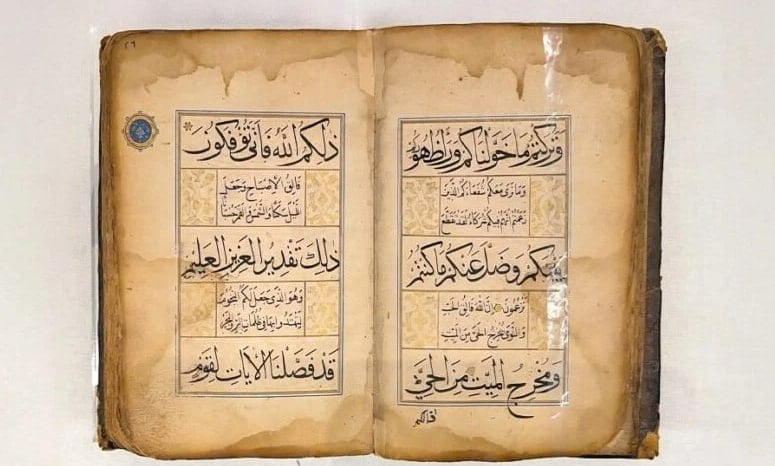
The Quran Museum in the Hira Cultural District in Makkah is displaying a rare Holy Quran manuscript believed to date back to the 12th century AH, corresponding to the 18th century CE, showcasing the deep care Muslims have devoted to preserving, writing, and decorating copies of the Quran throughout history.
The manuscript, which is part of the collections of the King Abdulaziz Public Library, represents an important example of the development of handwritten Quran manuscripts. It was written with black ink using a combination of traditional Islamic calligraphy styles, including Thuluth, Rayhani, and Naskh scripts, reflecting the skill of the calligrapher and the artistic precision employed in transcribing Quranic verses.
The verses in the manuscript were carefully marked with diacritical signs and vowel markings, while its pages feature intricate floral decorations and refined gilding, particularly in the opening sections. These artistic elements reflect the high status of the Quran among Muslims and their dedication to producing manuscripts of exceptional beauty and craftsmanship.
The manuscript also contains gilded circular markers placed between verses, serving both a practical role in organizing the text and an aesthetic purpose, following artistic traditions found in many historical Quran manuscripts.
Adding to its uniqueness, the manuscript includes a selection of Quranic chapters, beginning with Al-Fatihah, Al-An‘am, Al-Kahf, Saba’, Fatir, Ya-Sin, Al-Fath, Al-Waqi‘ah, Al-Mulk, and An-Naba’, and concluding with Surat Al-Ikhlas.
The exhibition provides visitors with an opportunity to explore the history of handwritten Quran manuscripts, the various schools of Arabic calligraphy used in their creation, and the techniques of decoration, gilding, and textual marking that accompanied Quran production across different eras.